
Key Takeaway 
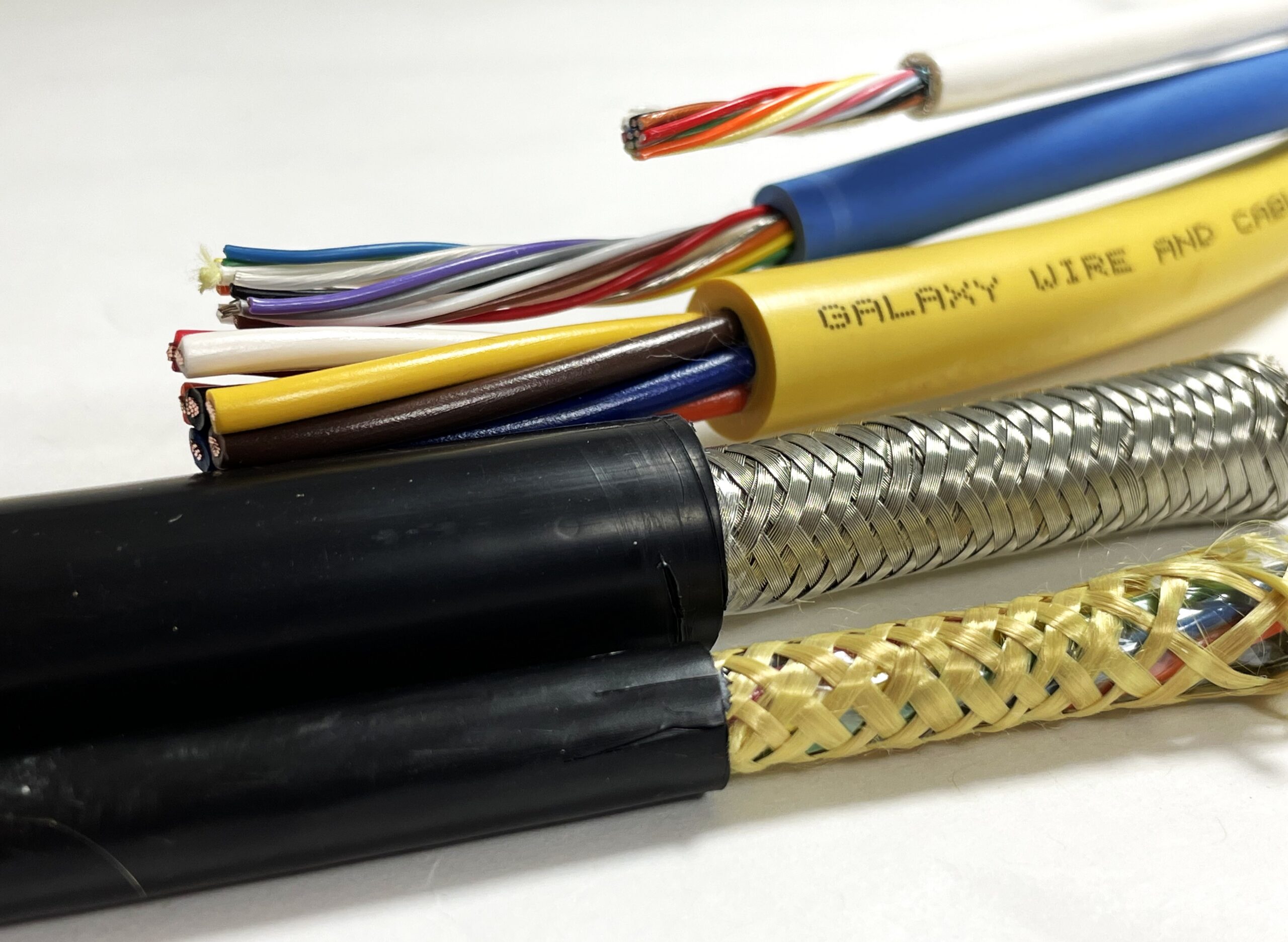
Composite (hybrid) cables combine multiple signal, power, data, or fluid elements into a single unified construction, reducing system complexity while improving reliability. Engineers specify hybrid cables to save space, simplify installation, improve EMI control, and increase long-term durability in demanding applications.
What is a composite or hybrid cable?
A composite (also called hybrid) cable integrates two or more distinct elements—such as power, data, control, coax, or pneumatics—into one engineered cable jacket.
Instead of running multiple separate cables through a system, a single composite cable provides:
- Electrical power
- Data or signal transmission
- Shielding and grounding
- Mechanical protection
All in one optimized construction.
Galaxy Wire & Cable regularly designs custom composite cables and assemblies tailored to application-specific electrical, mechanical, and environmental requirements.
Why do engineers choose composite cables instead of multiple discrete cables?
Using separate cables may seem simpler initially, but it often creates integration and reliability issues over time.
Composite cables solve common engineering problems by:
- Reducing cable congestion
- Minimizing connector count
- Improving EMI performance
- Simplifying routing and installation
- Lowering total system weight
For many systems, composite cables are not just convenient—they’re mission-critical.
Advantage #1: Reduced size, weight, and routing complexity
By combining multiple elements under a single jacket, composite cables:
- Reduce overall bundle diameter
- Lower system weight (especially vs. multiple jackets)
- Simplify cable management and routing
- Enable tighter bend radii in constrained spaces
This is especially valuable in:
- Aerospace and defense platforms
- Robotics and automation
- Transportation and mobile systems
- Medical equipment with tight enclosures
Advantage #2: Improved reliability through fewer failure points
Every connector and cable interface is a potential failure point.
Composite cables:
- Reduce the number of connectors required
- Eliminate inter-cable movement and fretting
- Improve strain relief consistency
- Reduce installation errors
Fewer terminations often translate directly to higher system uptime.
Advantage #3: Better EMI and signal integrity control
When power and data are routed independently, EMI issues often arise unintentionally.
Composite cable design allows engineers to:
- Precisely position conductors
- Apply individual and overall shielding
- Control impedance and crosstalk
- Separate noisy power from sensitive signals
Galaxy engineers routinely design hybrid constructions combining power conductors, twisted pairs, and coax while maintaining signal integrity.
Advantage #4: Faster, cleaner installation
From the installer’s perspective, composite cables mean:
- One cable pull instead of many
- Faster installation time
- Lower labor costs
- Reduced chance of mis-routing
In high-volume production or field deployment, these savings can be substantial.
Advantage #5: Improved performance in dynamic or harsh environments
Composite cables can be engineered for:
- Continuous flex or torsion
- Vibration and shock
- Wash-down or submerged environments
- Chemical or oil exposure
- Extreme temperatures
Rather than relying on cable ties or conduits to keep multiple cables together, the composite design maintains internal geometry under motion.
What types of elements can be combined in a hybrid cable?
Composite cable designs are highly flexible.
Common combinations include:
- Power + control
- Power + Ethernet or industrial fieldbus
- Power + coax (RF)
- Signal + sensor + power
- Power + data + pneumatic tubes
The optimal configuration depends on voltage levels, data rates, shielding needs, and mechanical constraints.
When does a composite cable make the most sense?
Composite cables are ideal when:
- Space or weight is constrained
- Systems move, flex, or rotate
- Installation time matters
- EMI risk is high
- Long-term reliability is critical
Typical applications
- Robotics and automation
- Medical imaging and diagnostic equipment
- Aerospace and defense systems
- Transportation and rail
- Industrial machinery
- Renewable energy and tracking systems
Are there trade-offs to composite cable design?
Like any engineered solution, composite cables require thoughtful design.
Potential considerations include:
- Higher upfront design effort
- Custom tooling or materials
- More complex termination strategies
However, these are usually outweighed by lifecycle cost savings, reliability gains, and performance improvements.
How does Galaxy Wire & Cable support composite cable projects?
Galaxy provides end-to-end support for composite and hybrid cable designs, including:
- Application review and requirements capture
- Electrical and mechanical design assistance
- Material and shielding selection
- Prototype builds and testing
- Full-scale production of cable and assemblies
Designs can be optimized for UL, CSA, mil-spec, medical, industrial, or transportation requirements.
Frequently Asked Questions (FAQ)
What is the difference between composite and hybrid cables?
The terms are often used interchangeably. Both refer to multiple functional elements integrated into one cable construction.
Are composite cables custom-only?
Most composite cables are custom-engineered, though they may be based on proven architectures.
Do composite cables cost more?
Upfront costs may be higher, but total system cost is often lower due to reduced labor, connectors, and failures.
Can Galaxy build composite cable assemblies?
Yes. Galaxy designs and manufactures complete composite cable assemblies, including overmolding and testing.
Considering a composite or hybrid cable design?
If your system currently uses multiple cables—or struggles with space, EMI, or reliability—a composite cable may be the right solution.
Request a composite cable design consultation or quote from Galaxy Wire & Cable today.